 Add to Chrome
 Add to Firefox
 Add to Edge
RAG-Match: Retrieval-Augmented Knowledge Injection and Hierarchical Reasoning for Calibrated Semantic Relevance
May 25, 2026
Semantic relevance judgment for search is particularly challenging in knowledge-intensive scenarios, where accurate ranking requires not only semantic matching but also background grounding, multi-step reasoning, and well-calibrated decision boundaries. Existing relevance models mainly rely on direct label supervision or shallow semantic similarity, which limits their ability to handle implicit intent, factual equivalence, and fine-grained relevance distinctions. To address this issue, we propose \textsc{RAG-Match}, a three-stage framework that integrates knowledge-augmented pretraining, hierarchical reasoning alignment, and preference-based decision calibration for relevance modeling. The key idea is to first strengthen query-centered semantic grounding, then align the model with structured relevance reasoning, and finally correct decision-level inconsistencies in difficult boundary cases. Experimental results on a real-world search relevance benchmark show that \textsc{RAG-Match} consistently outperforms strong LLM-based baselines across multiple ranking metrics, demonstrating the effectiveness of combining knowledge injection, reasoning supervision, and preference optimization for fine-grained relevance judgment.

A Comparative Evaluation of Structural Topic Models and BERTopic for Short, Open-Ended Survey Responses
May 21, 2026Topic modeling in applied psychology increasingly spans two methodological traditions: probabilistic bag-of-words models and newer embedding-based approaches. Yet many evaluations of these methods rely on longer and cleaner benchmark corpora, leaving less guidance for short, open-ended survey responses. This paper compares Structural Topic Models (STM), a probabilistic topic model, and BERTopic, an embedding-based model, for analyzing open-ended survey responses. We evaluated three STM conditions and five BERTopic conditions, varying typographical correction, stemming, embedding choice, and contextual augmentation, a strategy we introduced to provide additional semantic context for very short responses. Results indicate that BERTopic consistently produced higher topic coherence than STM, with contextual augmentation yielding the strongest performance gains. In contrast, higher-dimensional embeddings alone did not improve coherence and were associated with greater data loss. Qualitative evaluation showed that BERTopic generated more interpretable and stable topics, while STM topics were often broader and more mixed. However, STM provides stronger support for inferential covariate analysis, whereas BERTopic covariate comparisons are primarily descriptive. These findings suggest that STM and BERTopic offer complementary strengths. We conclude with practical guidance for selecting and combining topic modeling approaches in applied social science research.
GFMate: Empowering Graph Foundation Models with Test-time Prompt Tuning
May 14, 2026Graph prompt tuning has shown great potential in graph learning by introducing trainable prompts to enhance the model performance in conventional single-domain scenarios. Recent research has extended graph prompts to improve Graph Foundation Models (GFMs) by few-shot tuning auxiliary prompts. Despite their progress, most existing methods embed source-domain information into prompts, which serve either as input to GFMs or encoded during model pre-training. Such prompt entanglement with specific source domains and GFM pre-training strategy restricts their generalisability to other domains and different GFMs. Furthermore, existing GFM prompts merely rely on few-shot tuning for adaptation, neglecting the rich information in unlabelled target domain test data. Motivated by these insights, this paper aims to empower GFMs with pre-training-agnostic test-time graph prompt tuning, named GFMate. GFMate introduces centroid and layer prompts applied after pre-training on target domains, avoiding entanglement with specific source domains and model pre-training. In addition, a test-time complementary learning objective is devised to exploit both labelled and unlabelled target domain data for effective test-time prompt tuning. Extensive experiments on 12 benchmark datasets demonstrate the superior performance and efficiency of GFMate, achieving improvements of up to 30.63%. Code is available at https://github.com/YanJiangJerry/GFMate.
Block-R1: Rethinking the Role of Block Size in Multi-domain Reinforcement Learning for Diffusion Large Language Models
May 13, 2026Recently, reinforcement learning (RL) has been widely applied during post-training for diffusion large language models (dLLMs) to enhance reasoning with block-wise semi-autoregressive generation. Block size has therefore become a vital factor in dLLMs, since it determines the parallel decoding granularity and affects the rollout trajectories during RL optimisation, e.g., GRPO. Instead of investigating the effect of block size during inference on individual domains, this paper studies block size from a domain conflict perspective for dLLM RL post-training in multi-domain scenarios. The main contributions are: (1) a formulation of domain block size conflict in multi-domain RL for dLLMs, which will largely affect the post-training effectiveness for rollout-based RL methods; (2) a novel dataset, Block-R1-41K is constructed with a best-improved training block size for each sample, which also induces a Block Size Conflict Score to quantitatively measure the domain conflict; (3) a new benchmark, Block-R1, for flexible RL post-training for dLLMs in both single and cross domain; and (4) a simple yet powerful cross-domain post-training method with sample-level best-improved training block sizes. Extensive experiments on 13 distinct datasets, 7 latest RL algorithms and diverse dLLM backbones are comprehensively covered in Block-R1. The benchmark is open-sourced at https://github.com/YanJiangJerry/Block-R1 with the dataset released at https://huggingface.co/datasets/YanJiangJerry/Block-R1-41K.
Hierarchical Attacks for Multi-Modal Multi-Agent Reasoning
May 13, 2026Multi-modal multi-agent systems (MM-MAS) have gained increasing attention for their capacity to enable complex reasoning and coordination across diverse modalities. As these systems continue to expand in scale and functionality, investigating their potential vulnerabilities has become increasingly important. However, existing studies on adversarial attacks in multi-agent systems primarily focus on isolated agents or unimodal settings, leaving the vulnerabilities of MM-MAS largely underexplored. To bridge this gap, we introduce HAM$^{3}$, a Hierarchical Attack framework for multi-modal multi-agent systems that decomposes attacks into three interconnected layers. Specifically, at the perception layer, HAM$^{3}$ mounts attacks by perturbing visual inputs, textual inputs, and their fused visual-textual representations. At the communication layer, it performs communication-level attacks that corrupt message content and interaction topology, such as manipulating shared context or communication links to distort collective information flow. At the reasoning layer, it conducts reasoning-level attacks that interfere with each agent's cognitive pipeline, biasing reasoning trajectories and ultimately compromising final decisions. We evaluate HAM$^{3}$ on the GQA benchmark through multi-agent systems built on distinct reasoning paradigms including ReAct, Plan-and-Solve, and Reflexion. Experiments demonstrate that our framework achieves an Attack Success Rate of up to 78.3%, with reasoning-layer attacks being the most effective. More than half of the successful attacks lead multiple agents to produce consistent errors. These findings offer valuable insights for building more robust and interpretable multi-agent intelligence.
* Accepted to CVPR 2026
Break the Block: Dynamic-size Reasoning Blocks for Diffusion Large Language Models via Monotonic Entropy Descent with Reinforcement Learning
May 04, 2026Recent diffusion large language models (dLLMs) have demonstrated both effectiveness and efficiency in reasoning via a block-based semi-autoregressive generation paradigm. Despite their progress, the fixed-size block generations remain a critical bottleneck for effective and coherent reasoning. 1. From a global perspective, different reasoning tasks would correspond to different optimal decoding block sizes, which makes a ``one-size-fits-all'' assumption ineffective. 2. Even within a single reasoning task, the rigid block partitioning would break the logical flow and reduce reasoning coherence. Through empirical observations, we reveal that for block-wise entropy, incorrect reasoning exhibits a fluctuating and unsteady trend between blocks, whereas the correctly generated tasks follow a consistent descending trend. Therefore, this paper proposes b1, a novel post-training framework for dLLMs that learns dynamic-size reasoning blocks via a Monotonic Entropy Descent objective with reinforcement learning to enhance reasoning coherence.b1 integrates seamlessly as a plug-and-play module with existing dLLM's post-training algorithms. Extensive experiments across various reasoning benchmarks showcase b1's consistent improvement over existing fixed-size block baselines. Our code has been released at https://github.com/YanJiangJerry/Block-R1.
TaFall: Balance-Informed Fall Detection via Passive Thermal Sensing
Apr 06, 2026Falls are a major cause of injury and mortality among older adults, yet most incidents occur in private indoor environments where monitoring must balance effectiveness with privacy. Existing privacy-preserving fall detection approaches, particularly those based on radio frequency sensing, often rely on coarse motion cues, which limits reliability in real-world deployments. We introduce TaFall, a balance-informed fall detection system based on low-cost, privacy-preserving thermal array sensing. The key insight is that TaFall models a fall as a process of balance degradation and detects falls by estimating pose-driven biomechanical balance dynamics. To enable this capability from low-resolution thermal array maps, we propose (i) an appearance-motion fusion model for robust pose reconstruction, (ii) physically grounded balance-aware learning, and (iii) pose-bridged pretraining to improve robustness. TaFall achieves a detection rate of 98.26% with a false alarm rate of 0.65% on our dataset with over 3,000 fall instances from 35 participants across diverse indoor environments. In 27 day deployments across four homes, TaFall attains an ultra-low false alarm rate of 0.00126% and a pilot bathroom study confirms robustness under moisture and thermal interference. Together, these results establish TaFall as a reliable and privacy-preserving approach to fall detection in everyday living environments.
Overview of CHIP 2025 Shared Task 2: Discharge Medication Recommendation for Metabolic Diseases Based on Chinese Electronic Health Records
Nov 09, 2025Discharge medication recommendation plays a critical role in ensuring treatment continuity, preventing readmission, and improving long-term management for patients with chronic metabolic diseases. This paper present an overview of the CHIP 2025 Shared Task 2 competition, which aimed to develop state-of-the-art approaches for automatically recommending appro-priate discharge medications using real-world Chinese EHR data. For this task, we constructed CDrugRed, a high-quality dataset consisting of 5,894 de-identified hospitalization records from 3,190 patients in China. This task is challenging due to multi-label nature of medication recommendation, het-erogeneous clinical text, and patient-specific variability in treatment plans. A total of 526 teams registered, with 167 and 95 teams submitting valid results to the Phase A and Phase B leaderboards, respectively. The top-performing team achieved the highest overall performance on the final test set, with a Jaccard score of 0.5102, F1 score of 0.6267, demonstrating the potential of advanced large language model (LLM)-based ensemble systems. These re-sults highlight both the promise and remaining challenges of applying LLMs to medication recommendation in Chinese EHRs. The post-evaluation phase remains open at https://tianchi.aliyun.com/competition/entrance/532411/.
Does Homophily Help in Robust Test-time Node Classification?
Oct 25, 2025Homophily, the tendency of nodes from the same class to connect, is a fundamental property of real-world graphs, underpinning structural and semantic patterns in domains such as citation networks and social networks. Existing methods exploit homophily through designing homophily-aware GNN architectures or graph structure learning strategies, yet they primarily focus on GNN learning with training graphs. However, in real-world scenarios, test graphs often suffer from data quality issues and distribution shifts, such as domain shifts across users from different regions in social networks and temporal evolution shifts in citation network graphs collected over varying time periods. These factors significantly compromise the pre-trained model's robustness, resulting in degraded test-time performance. With empirical observations and theoretical analysis, we reveal that transforming the test graph structure by increasing homophily in homophilic graphs or decreasing it in heterophilic graphs can significantly improve the robustness and performance of pre-trained GNNs on node classifications, without requiring model training or update. Motivated by these insights, a novel test-time graph structural transformation method grounded in homophily, named GrapHoST, is proposed. Specifically, a homophily predictor is developed to discriminate test edges, facilitating adaptive test-time graph structural transformation by the confidence of predicted homophily scores. Extensive experiments on nine benchmark datasets under a range of test-time data quality issues demonstrate that GrapHoST consistently achieves state-of-the-art performance, with improvements of up to 10.92%. Our code has been released at https://github.com/YanJiangJerry/GrapHoST.
Hyperspectral Mamba for Hyperspectral Object Tracking
Sep 10, 2025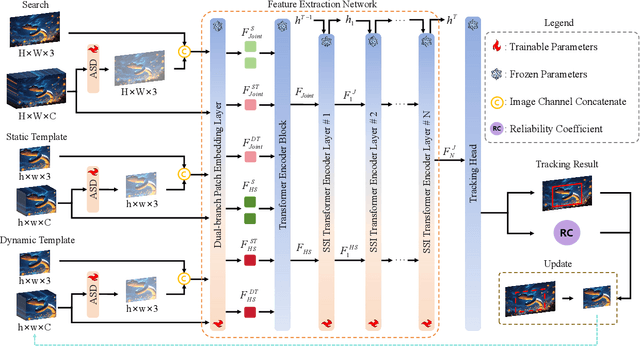
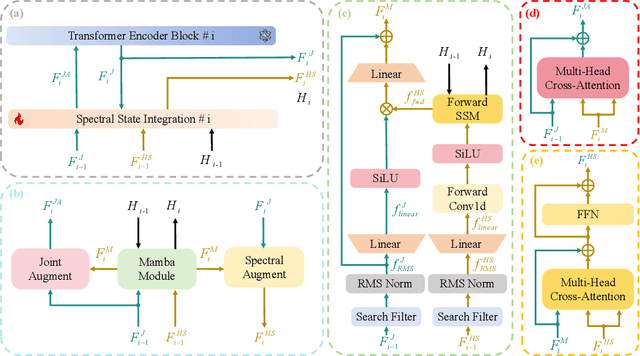
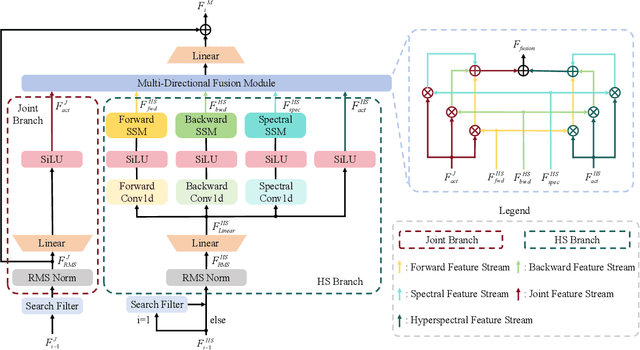
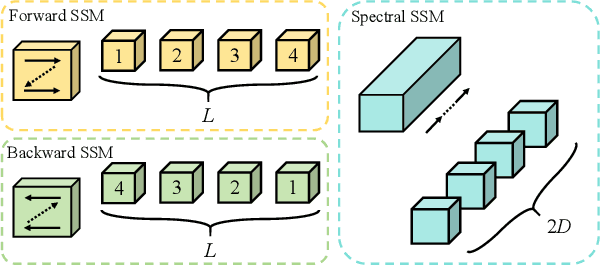
Hyperspectral object tracking holds great promise due to the rich spectral information and fine-grained material distinctions in hyperspectral images, which are beneficial in challenging scenarios. While existing hyperspectral trackers have made progress by either transforming hyperspectral data into false-color images or incorporating modality fusion strategies, they often fail to capture the intrinsic spectral information, temporal dependencies, and cross-depth interactions. To address these limitations, a new hyperspectral object tracking network equipped with Mamba (HyMamba), is proposed. It unifies spectral, cross-depth, and temporal modeling through state space modules (SSMs). The core of HyMamba lies in the Spectral State Integration (SSI) module, which enables progressive refinement and propagation of spectral features with cross-depth and temporal spectral information. Embedded within each SSI, the Hyperspectral Mamba (HSM) module is introduced to learn spatial and spectral information synchronously via three directional scanning SSMs. Based on SSI and HSM, HyMamba constructs joint features from false-color and hyperspectral inputs, and enhances them through interaction with original spectral features extracted from raw hyperspectral images. Extensive experiments conducted on seven benchmark datasets demonstrate that HyMamba achieves state-of-the-art performance. For instance, it achieves 73.0\% of the AUC score and 96.3\% of the DP@20 score on the HOTC2020 dataset. The code will be released at https://github.com/lgao001/HyMamba.